Your Cart (0)

Accucold Vaccine Refrigerator Buying Guide: CDC Storage Rules, Sizes and Models
What the CDC requires for vaccine storage and how to choose an Accucold vaccine refrigerator: temperatures, data loggers, NSF/ANSI 456, sizes and models.
by Spectra Services • November 17, 2026
Why vaccines need a purpose-built refrigerator
Vaccines lose potency when they get too warm or freeze, and you usually cannot tell by looking at the vial. A household refrigerator cycles on and off, has warm and cold spots, and can freeze anything placed near the cooling plate. That is why the CDC recommends purpose-built units for vaccine storage and why many state Vaccines for Children (VFC) programs set rules for the equipment providers use.
This guide covers what the CDC asks for, what NSF/ANSI 456 certification means, and how to choose an Accucold vaccine refrigerator for your practice, pharmacy or clinic.
The CDC basics
Temperature
Refrigerated vaccines must stay between 2°C and 8°C (36°F and 46°F). The CDC suggests setting the thermostat near the middle of that range, around 5°C (40°F), to leave margin on both sides. Frozen vaccines belong in a separate freezer held between -50°C and -15°C (-58°F and +5°F).
Unit type
Purpose-built refrigerators and freezers are preferred. They come as compact, under-counter and full-size upright models. If a household unit must be used, it should be a stand-alone refrigerator, and vaccines should never go in a combination unit's freezer. Dormitory-style or bar-style combination units must not be used for vaccines under any circumstances.
Monitoring
Every vaccine storage unit needs a digital data logger (DDL) with a buffered probe placed with the vaccines. The CDC toolkit asks for a logger that:
- Uses a detachable probe in a buffer, such as glycol or glass beads, so it reads product temperature rather than air temperature.
- Alarms when the temperature goes out of range.
- Shows current, minimum and maximum temperatures.
- Has a low battery indicator.
- Has an accuracy of plus or minus 0.5°C (1°F).
- Records at least every 30 minutes, with an interval the user can set.
- Comes with a current certificate of calibration testing.
Staff should also check and record the minimum and maximum temperatures at the start of each workday. Some state programs still ask for a second check at the end of the day. Check your state immunization program's current rules.
Good storage practice
Keep vaccines in their original packaging with lids closed. Do not store food or drinks in the unit. Leave space between packages and the walls so air can circulate, and keep vaccines off the floor and out of the door.
What NSF/ANSI 456 adds
NSF/ANSI 456 is a vaccine storage standard that tests refrigerators for how well they hold the 2°C to 8°C range under real conditions, including door openings, varied loads and changes in room temperature. A certified unit has been independently tested against those conditions. Certification is not a CDC requirement, but it is the clearest evidence that a refrigerator will do the job, and some programs and purchasing departments now ask for it.
A closer look at one model: Accucold ARG8PV456
The Accucold ARG8PV456 is an 8 cubic foot upright vaccine refrigerator certified to NSF/ANSI 456. It is a common choice for pediatric and family practices that need full-size capacity in a small footprint.
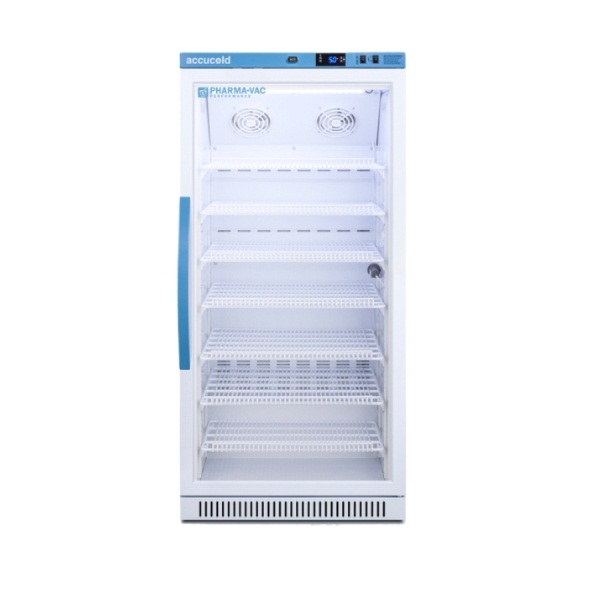
- Capacity: 8.0 cu ft (227 L).
- Temperature: adjustable from 2°C to 8°C, with a published variation of plus or minus 1°C.
- Controller: digital microprocessor controller with an LED readout in Celsius or Fahrenheit, resettable min/max memory, and password protection beyond the set point.
- Alarms: high and low temperature, power failure (battery powered), door ajar (adjustable from 1 to 99 minutes), and sensor failure, plus remote alarm contacts on the back.
- Monitoring: a 1/2 inch probe port in the side wall for your own logger, with factory-installed NIST-calibrated USB data logger and wireless monitoring options.
- Door and shelves: self-closing double-pane tempered glass door with a keyed lock and seven adjustable shelves.
- Size: 50 inches high by about 23 1/2 inches wide and 24 1/2 inches deep, running on standard 115 V power.
- Warranty: two years parts and labor, five years on the compressor, with a two-year calibration certificate included.
Choosing the right size
Undersizing is the most common mistake. During flu season and back-to-school months, inventory can double, and packing a refrigerator tight blocks airflow and creates warm spots.
- Compact and counter-height units (about 1 to 3 cu ft): small satellite clinics, school nurse offices and low-volume pharmacies.
- Under-counter units (about 3 to 5 cu ft): practices that want storage at the point of care without giving up floor space.
- Upright units (about 8 to 12 cu ft and up): busy pediatric, family medicine and pharmacy operations, and anyone storing a full seasonal flu order.
- A practical rule: size for your largest month, then add room for air to move around every box.
Features that make compliance easier
- Glass door: lets staff find vaccine quickly without holding the door open.
- Keyed lock: keeps the unit secure and prevents someone from unplugging or adjusting it.
- External controls: settings can be checked without opening the door.
- Built-in or factory-installed data logger: removes one more device to buy and calibrate.
- Door alarm: catches the door left ajar at the end of the day.
VFC program requirements
If you store Vaccines for Children (VFC) stock, your state program sets the rules, and most follow the CDC toolkit: a stand-alone, purpose-built or pharmaceutical grade unit (never a dormitory style or bar style unit), a calibrated digital data logger with a buffered probe in every unit, a backup data logger, and a min/max temperature check recorded at the start of each workday. Check the current CDC Vaccine Storage and Handling Toolkit and your state program for the latest version. A purpose-built Accucold unit with a data logger covers the equipment side of that list.
Setting up the refrigerator
Put the probe in the center of the unit, with the vaccines, away from walls, vents and the door. Keep water bottles on the floor and in the door, where vaccines should not go, to steady the temperature during door openings and outages. Plug the unit straight into the wall, not a power strip, and label the plug and breaker "Do Not Unplug". Let a new unit run for two to seven days and confirm stable readings before you stock it.
What to do after a temperature excursion
- Label the affected vaccine "Do Not Use" and keep it stored at the correct temperature. Do not throw it away.
- Use the data logger to record the temperature reached and how long the unit was out of range.
- Record the lot numbers and expiration dates of the affected vaccine.
- Contact the vaccine manufacturers and your state immunization program for guidance on whether the vaccine can be used.
- Document the event and what you did, then fix the cause before restocking.
Frequently asked questions
What temperature should a vaccine refrigerator be?
Between 2°C and 8°C (36°F and 46°F), with the set point around 5°C (40°F).
Can I use a household refrigerator for vaccines?
The CDC prefers purpose-built units. If a household unit is used, it must be a stand-alone refrigerator, never a dormitory or bar-style combination unit.
Do I need a data logger if the refrigerator has a display?
Yes. The CDC calls for a digital data logger with a buffered probe and a current calibration certificate in every vaccine storage unit.
What does NSF/ANSI 456 certified mean?
The model has been independently tested to hold vaccine storage temperatures under conditions such as door openings and changing room temperatures.
How big a vaccine refrigerator do I need?
Size for your busiest month, including flu season, and leave space around boxes for airflow.
How often should I check and reset the min/max reading?
At the start of each workday. Record the minimum and maximum temperatures on your log, then reset the reading so the next check covers only the time since.
What should I do if the vaccine refrigerator gets too warm or too cold?
Do not discard the vaccine. Mark it "Do Not Use", keep it at the correct temperature, record what the data logger shows and call the manufacturers and your state program. The full checklist is above.
Which vaccines are most sensitive to freezing?
Many refrigerated vaccines lose potency if they freeze, so for most refrigerated stock a cold excursion is a bigger risk than a brief warm one. Check each manufacturer's package insert for its limits.
Get a quote on Accucold vaccine storage
Spectra Services supplies Accucold vaccine refrigerators and freezers, data loggers and accessories. Tell us your peak inventory and your space, and we will recommend a model. Call 585.265.4320 or request a quote.
overall rating:
my rating:
log in to rate