Your Cart (0)

Gravity vs. Forced Air Lab Drying Ovens: How to Choose a Laboratory Oven
Gravity or forced air? How to choose a lab drying oven by sample, uniformity, recovery time and price, with examples from Grieve, Yamato and Quincy.
by Spectra Services • November 17, 2026
What is a laboratory oven?
A laboratory oven is a heated chamber used to dry, bake, cure, anneal or sterilize samples and glassware at controlled temperatures above room temperature, typically up to about 250 to 300°C for general purpose models. You will also see them called drying ovens, lab drying ovens or convection ovens.
Start with how the air moves
Every lab oven heats a chamber. What separates one model from another is how heat gets from the elements to your samples. That comes down to airflow, and there are two main designs: gravity convection and forced convection, sometimes called forced air or mechanical convection. ASTM E145, the standard specification for laboratory ovens, treats them as two distinct types for a reason. They behave differently with the same samples.
Gravity convection ovens
In a gravity oven, heated air rises on its own and cooler air sinks, setting up a slow natural circulation. There is no fan.
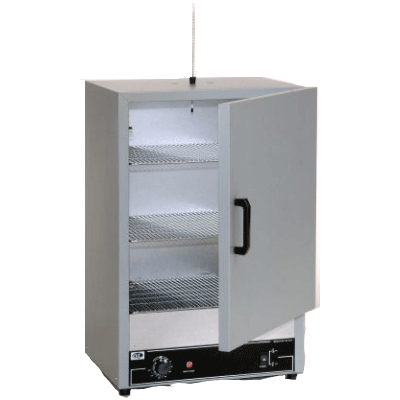
Where gravity ovens shine:
- Light powders and fine particles that a fan would scatter.
- Gentle drying of heat-sensitive samples.
- Petri dishes, sterilizing glassware and general drying where tight uniformity is not critical.
- Budget purchases, since fewer moving parts mean lower cost and less maintenance.
The trade-offs are slower heat-up, slower recovery after the door opens, and larger temperature differences from top to bottom of the chamber, especially when the oven is fully loaded.
Examples: the Quincy Lab 40GC is a 3.0 cubic foot gravity convection oven that reaches 450°F on a standard 115 V outlet. The Yamato DVS602C is a gravity convection oven rated to 260°C, a common choice for drying and sterilizing in teaching and QC labs.
Forced convection ovens
A forced convection oven uses a blower to move air across the elements and through the chamber. That active circulation changes three things.

- Uniformity: air reaches every shelf at close to the same temperature, which matters when you load several shelves or need repeatable results.
- Speed: chambers heat up faster and recover faster after the door is opened.
- Drying rate: moving air carries moisture away from the samples, so drying cycles are shorter.
Choose forced convection for moisture determination, curing and aging of materials, heat treating, burn-in testing, and any protocol with a tight temperature tolerance.
Example: the Grieve NB-350 is a mechanical convection bench oven with a 7 cubic foot chamber and a 350°F maximum, built for continuous industrial and lab use.
Vacuum ovens, briefly
A vacuum oven lowers the pressure in the chamber so samples dry at lower temperatures. It is the right tool for heat-sensitive materials, samples that oxidize in air, and removing solvents from small batches. Vacuum ovens are a separate category from gravity and forced air models; ask us if your work needs one.
Five questions that narrow the choice
1. What are you heating?
Fine powders and lightweight samples point to gravity convection. Dense loads, multiple shelves and moisture-heavy samples point to forced air.
2. How tight does the temperature need to be?
If a standard method or your QA program sets a tolerance, look at published uniformity and stability figures, not just the maximum temperature. Ask how the oven performs fully loaded and how quickly it recovers after the door is opened.
3. What temperature do you actually run at?
Most lab ovens top out somewhere between 200°C and 300°C. Choose a model with comfortable headroom above your normal set point, but buy for the range you use daily. Stable control at 105°C matters more than a 300°C maximum you never reach.
4. How big does the chamber need to be?
Measure your largest load, then check usable shelf area, shelf spacing and maximum shelf load. Leave room for air to move around samples, especially in a gravity oven. A slightly larger chamber than you need today allows for growth and better airflow.
5. What power is available?
Small benchtop units like the Quincy 40GC run on 115 V. Larger and industrial ovens often need 208 to 240 V, sometimes three phase. Check your outlets and breaker capacity before you order.
Safety: flammable solvents need a different oven
Standard laboratory ovens are built for non-flammable samples, solids and glassware. Do not use them to dry samples that release flammable solvent vapors. Those applications need an oven designed for solvent atmospheres, and your facility safety officer should be part of the decision. Also look for an independent over-temperature controller, which shuts the heat off if the main controller fails.
Controller features worth paying for
- Digital setpoint and readout instead of a dial.
- Programmable ramp and soak for curing and annealing cycles.
- Timers and alarms so long runs do not need constant attention.
- Ports for an independent probe or data logger when you need documented temperatures.
Gravity vs. forced air at a glance
| Gravity convection | Forced air convection | |
|---|---|---|
| How air moves | Warm air rises naturally | A fan circulates the air |
| Typical uniformity | About ±3 to 5°C | About ±1 to 2°C |
| Recovery after the door opens | Slower | Faster |
| Light powders | Not disturbed | Can blow around unless fan speed adjusts |
| Drying speed in dense loads | Slower | Faster |
| Price | Lower | Higher |
| Best for | Powders, light samples, gentle drying | Glassware, dense loads, tight tolerance work |
Surface drying and crusting
Hot, fast moving air can dry the outside of a sample before the moisture inside escapes. The surface forms a crust that traps water and throws off moisture results. If you dry soils, aggregates, food or thick pastes, start at a lower setpoint, choose gravity convection or an adjustable fan, and dry to constant weight.
How much does a laboratory oven cost?
Small benchtop gravity ovens start under $1,000, larger forced air models run several thousand dollars, and big Grieve walk-in and industrial ovens can pass $10,000. Treat these as rough ranges and ask Spectra for a current quote. Price climbs with chamber size, maximum temperature, uniformity and controller features.
Frequently asked questions
What is the difference between a gravity and a forced air oven?
A gravity oven relies on natural convection with no fan. A forced air oven uses a blower, which gives better uniformity, faster heat-up and faster drying.
Which is better for drying glassware?
Either works. A gravity oven is often enough and costs less. Choose forced air if you dry large loads on several shelves and want shorter cycles.
Can I use a lab oven for sterilization?
Dry heat sterilization of glassware is a common use. For liquids, media and many plastics you need an autoclave.
How hot do lab ovens get?
Typical general purpose lab ovens reach roughly 200°C to 300°C. The Quincy 40GC reaches 450°F (about 232°C) and the Yamato DVS602C reaches 260°C.
What does ASTM E145 cover?
It is the standard specification for gravity convection and forced ventilation ovens used in laboratories, including how their performance is defined and tested.
What is a lab oven called?
Laboratory oven, drying oven, convection oven, gravity convection oven or forced air oven. Vacuum ovens and cleanroom ovens are specialized types.
How much does a lab oven cost?
From under $1,000 for a small benchtop gravity oven to well over $10,000 for large industrial models. See the cost section above.
Get a recommendation
Spectra Services carries laboratory ovens from Grieve, Yamato, Quincy and other manufacturers, and our team can match an oven to your samples, chamber size and power supply. Call 585.265.4320 or request a quote with your application details.
overall rating:
my rating:
log in to rate