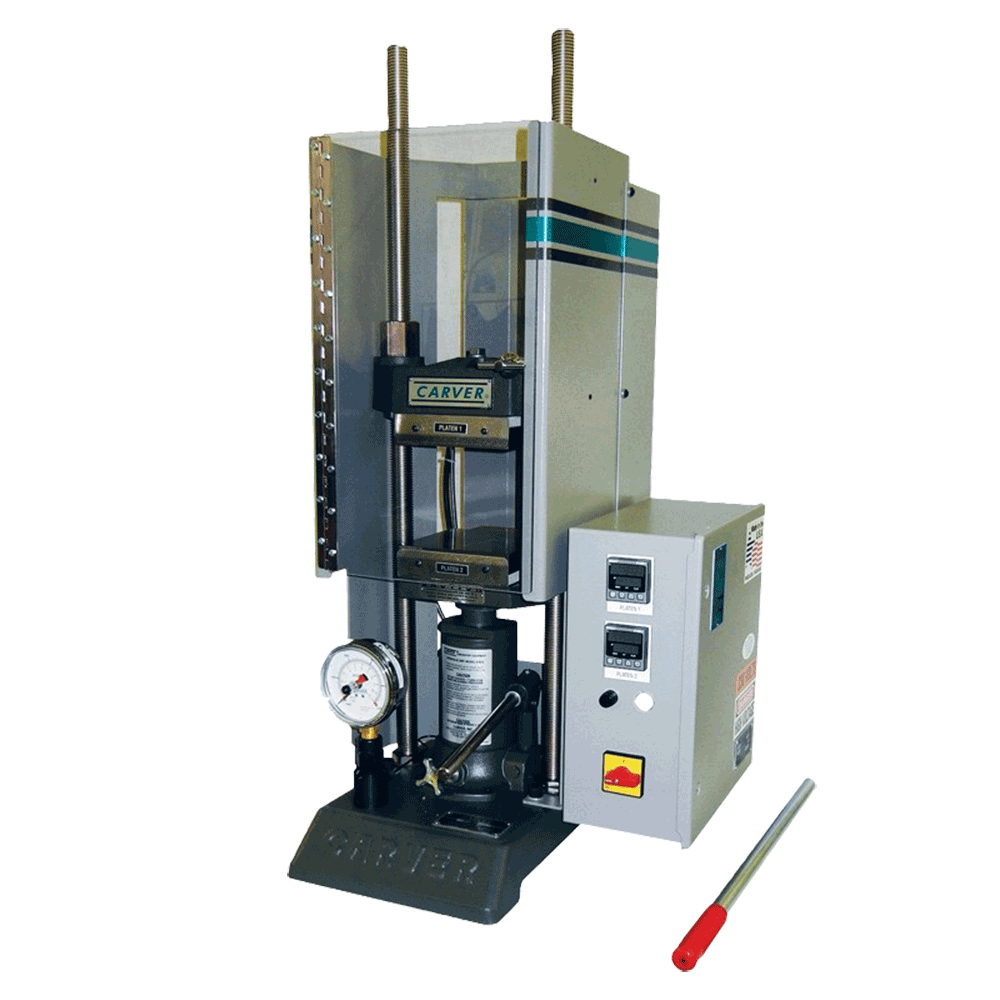
What a lab press does A laboratory press applies a controlled, measured force between two flat platens. Labs use them to make KBr pellets for FTIR, pressed pellets for XRF, molded polymer test plaques, laminates, and to test how materials compact or extract under pressure. Carver has built lab presses for decades, and their range covers almost every one of those jobs. Choosing the right model comes down to three decisions: manual or automatic, heated or unheated, and how much force you need. Manual or automatic Manual presses On a manual Carver press, the operator pumps a hand lever to build hydraulic pressure and reads force on a gauge. Manual presses are simple, durable and need no power for the pressing itself (heated models need power for the platens). Choose manual when: You press a modest number of samples per day. Your method allows for operator-controlled force and hold time. Budget matters, or you want a press that works anywhere on the bench. Automatic presses Carver's Auto Series presses build and hold force automatically, and the Auto Series Plus line adds a 7 inch touchscreen that stores up to 250 recipes. The operator selects a recipe and starts the cycle; the press handles the force, the hold and, on heated models, the temperature profile. Choose automatic when: Results must be repeatable between operators and shifts. You follow a written method with defined force, temperature and dwell steps. Throughput is high enough that hand pumping becomes a bottleneck. You need to document each cycle for quality or regulatory records. Heated or unheated Unheated presses make pellets and compacts at room temperature. Most FTIR KBr pellets and many XRF pellets are pressed cold. Carver CH manual heated press (4386) Heated presses have electrically heated platens with digital temperature control. They are used for compression molding thermoplastics, curing thermosets, laminating, and making film samples for spectroscopy. Carver's heated benchtop manual presses reach platen temperatures of 650°F. Some models (marked C in the model name) add water-cooled platens so you can cool a molded part under pressure, which controls shrinkage and warping. Carver benchtop heated models at a glance Model Part no. Force Platens Cooling CH 4386 12 tons 6 x 6 in No Mini CH 5420 12 tons 6 x 6 in No 12-10H 4120 12 tons 10 x 7 in No 12-12H 4122 12 tons 12 x 12 in No 12-12H,C 4123 12 tons 12 x 12 in Yes MH,C 4389 25 tons 9 x 9 in Yes 25-12H 3856 25 tons 12 x 12 in No 25-12H,C 4126 25 tons 12 x 12 in Yes 30-12H 4128 30 tons 12 x 12 in No For pellet work, Carver also makes the manual pellet press 4350.L , a compact press built specifically for making pellets with a die. How to pick tonnage The number on the press is total force. What your sample feels is pressure, which is force divided by the area it acts on. That is why a small press can make a hard pellet while a large molding job needs far more tonnage. Carver 25-12H, 25 tons (3856) Pressure (psi) = force in tons x 2,000 / area in square inches. Two examples with a 12 ton press: A 1 inch diameter pellet die has an area of about 0.785 square inches. At 12 tons, that is about 30,600 psi on the sample. Plenty for most pellets. A full 6 x 6 inch molding plaque has an area of 36 square inches. At 12 tons, that is only about 670 psi. For a molding job that needs 1,500 psi across the plaque, you would need about 27 tons, which points to a 30 ton press. Work out the pressure your method calls for, multiply by the area of your die or mold, and pick a press with 20 to 30 percent headroom so you are not running at the limit of the gauge. Platen size Platen size should cover your largest mold with room to spare. A 6 x 6 inch platen suits pellet dies and small molds. Choose 9 x 9 or 12 x 12 inch platens for larger plaques, multiple-cavity molds or laminates. Remember that bigger platens on the same tonnage mean lower pressure if you spread the load across them. A quick decision guide KBr pellets for FTIR, a few a day: unheated manual press, 12 tons, or the 4350.L pellet press. XRF pellets, high throughput: automatic press for repeatability. Polymer films for spectroscopy: heated manual press such as the CH (4386). Compression molded test plaques: heated press with cooling, 25 to 30 tons, 12 x 12 inch platens. Validated QC methods: Auto Series Plus with stored recipes. Safety and care Use the safety shield. Keep hands clear of the platens during pressing and use the gauge, not feel, to judge force. On heated presses, allow platens to cool or use heat-resistant gloves when loading. Check the hydraulic oil level and look for leaks on a regular schedule, and have the gauge checked if readings drift. New or used? Used Carver presses are common on the resale market, and a well kept manual press can work for decades. The risks are worn seals, an uncalibrated gauge, platens that are no longer flat, and no warranty or service history. A new press comes calibrated, with current safety guards and support. If your results must be traceable, add gauge calibration and a possible rebuild to the price of a used press before comparing. How much does a Carver press cost? Manual benchtop presses cost the least, heated platens add to the price, and automatic models cost the most. Ask Spectra for a quote on the tonnage, platen size and heating you need. Presses for ASTM and compression testing Carver also builds presses set up for standard test methods, used in materials labs for compression testing and specimen preparation. If your work follows an ASTM method, send us the method number and specimen size and we will help you match a press and fixtures. Frequently asked questions How many tons do I need for KBr pellets? For a typical 13 mm die, many labs use around 8 to 10 tons. Follow your die manufacturer's rating so you do not exceed it. What is the difference between Carver manual and auto presses? Manual presses are pumped by hand and read from a gauge. Auto presses build and hold force automatically, and the Auto Series Plus stores up to 250 recipes on a touchscreen. How hot do Carver heated presses get? Carver's heated benchtop manual presses reach 650°F platen temperature. Why choose a press with cooling? Cooling the platens under pressure sets molded parts before release, reducing warping and shrinkage. Does a bigger platen mean more pressure? No. For the same force, a larger area means lower pressure on the sample. How much does a Carver press cost? It depends on tonnage, platen size, heating and controls. Manual models cost the least and automatic models the most. Ask Spectra for a quote on the configuration you need. What are the main types of lab press? Manual and automatic. Within each, presses are heated or unheated, and they come in different tonnages and platen sizes. Get help choosing a Carver press Spectra Services sells Carver laboratory presses, pellet dies and accessories. Tell us your sample, die or mold size and the pressure your method needs, and we will recommend a model. Call 585.265.4320 or request a quote. Shop Carver presses See the 4350L pellet press {"@context": "https://schema.org", "@type": "FAQPage", "mainEntity": [{"@type": "Question", "name": "How many tons do I need for KBr pellets?", "acceptedAnswer": {"@type": "Answer", "text": "For a typical 13 mm die, many labs use around 8 to 10 tons. Follow your die manufacturer's rating so you do not exceed it."}}, {"@type": "Question", "name": "What is the difference between Carver manual and auto presses?", "acceptedAnswer": {"@type": "Answer", "text": "Manual presses are pumped by hand and read from a gauge. Auto presses build and hold force automatically, and the Auto Series Plus stores up to 250 recipes on a touchscreen."}}, {"@type": "Question", "name": "How hot do Carver heated presses get?", "acceptedAnswer": {"@type": "Answer", "text": "Carver's heated benchtop manual presses reach 650\u00b0F platen temperature."}}, {"@type": "Question", "name": "Why choose a press with cooling?", "acceptedAnswer": {"@type": "Answer", "text": "Cooling the platens under pressure sets molded parts before release, reducing warping and shrinkage."}}, {"@type": "Question", "name": "Does a bigger platen mean more pressure?", "acceptedAnswer": {"@type": "Answer", "text": "No. For the same force, a larger area means lower pressure on the sample."}}, {"@type": "Question", "name": "How much does a Carver press cost?", "acceptedAnswer": {"@type": "Answer", "text": "It depends on tonnage, platen size, heating and controls. Manual models cost the least and automatic models the most. Ask Spectra for a quote on the configuration you need."}}, {"@type": "Question", "name": "What are the main types of lab press?", "acceptedAnswer": {"@type": "Answer", "text": "Manual and automatic. Within each, presses are heated or unheated, and they come in different tonnages and platen sizes."}}]}